The patient still has delirium. What needs attention today? Five questions for reviewing causes, recovery, distress, complications and the shared plan.
In this article
- What guidance is available?
- 1. What has changed since the previous review?
- 2. What is driving the delirium now?
- 3. Are we supporting brain recovery and relieving distress?
- 4. Are we preventing complications?
- 5. Does everyone understand the plan?
- Making a structured review work
- References
- Guidance and practical resources
You see a patient with delirium, identify several likely causes, provide reassurance, start treatment, and inform the family.
On the next ward round, the patient still has delirium. And on the ward round after that, there may or may not be improvement. This is the normal picture in delirium care.
Delirium is a complicated condition and like many acute medical conditions the process of care involves diagnosis and initiation of treatment followed by ongoing monitoring and appropriate actions.
So with patients who have delirium we need to keep reviewing our patients, often over several days, sometimes much longer. In fact a systematic review estimated that 36% of older hospital patients with delirium still had it at discharge (95% confidence interval 22% to 51%; Whitby et al., 2022).
Yet much of our teaching concentrates on the first assessment. How do we detect delirium? What are the causes? What should we do immediately? All necessary questions.
But what should a good medical ward round look like when we return to somebody who still has delirium? What should the ongoing process of care look like?
What guidance is available?
There is a lot of useful work on ward rounds to draw on. The Royal College of Physicians' Modern ward rounds guidance describes a multidisciplinary review involving patients, with preparation, coordination, and clear communication of the plan (RCP et al., 2021). A 2025 systematic review covering 84 studies found that ward-round checklists improved documentation, without evidence that they increased ward-round duration. Most studies were observational, and improvements in general hospital length of stay and mortality were not demonstrated (Treloar et al., 2025).
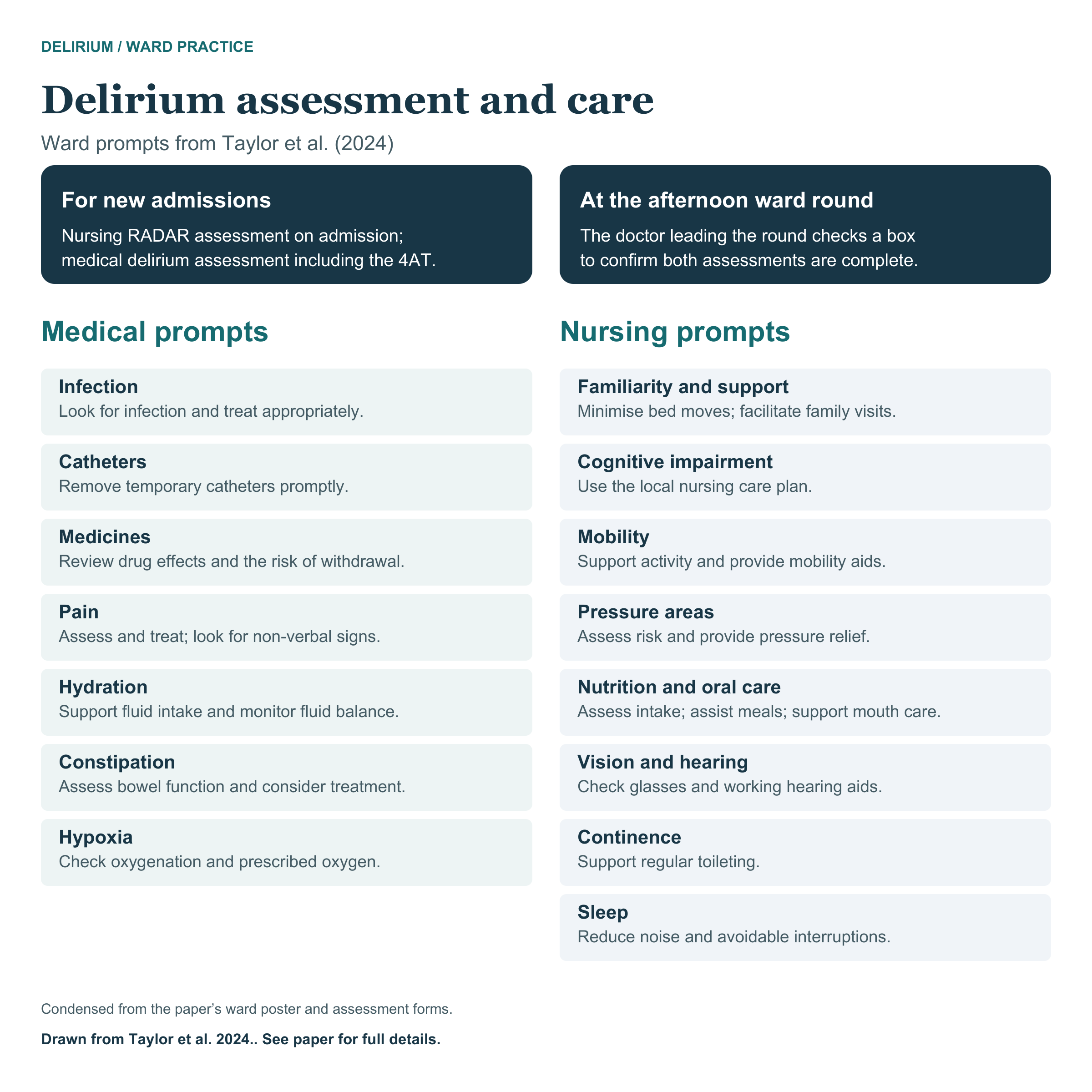
There are also delirium-specific projects. Taylor and colleagues used ward-based prompts, including an afternoon ward-round check, to improve delirium assessment in an acute senior health unit (Taylor et al., 2024). This was local quality-improvement work, mainly about assessment and adherence to guidance. We still have limited evidence on how best to organise the full daily medical review of established delirium.
The Delirium 8 framework on the4AT.com provides a useful starting point. Some elements concern first presentation, particularly the urgent search for life-threatening causes. Many apply throughout the illness: treating causes, supporting brain recovery, relieving distress, preventing complications, communicating, and planning rehabilitation and follow-up. New deterioration requires another urgent assessment, whatever day of the admission it happens.
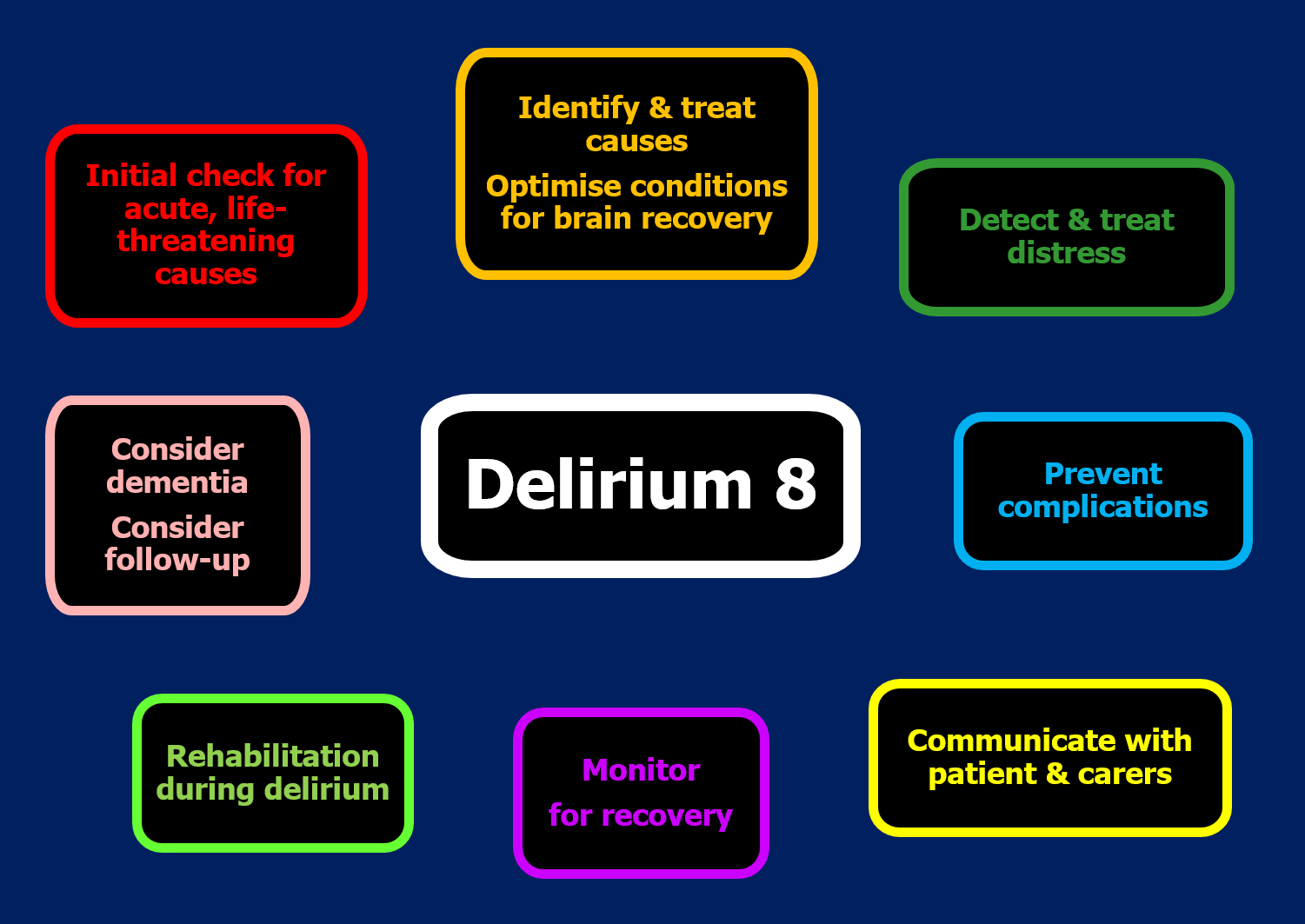
Delirium 8: eight priorities for delirium care. Source: the4AT.com.
I think we can bring these elements into a practical ward-round review. My suggested daily multidomain review sheet groups them under five questions. Here is how I would use those questions in ongoing care on a general ward.
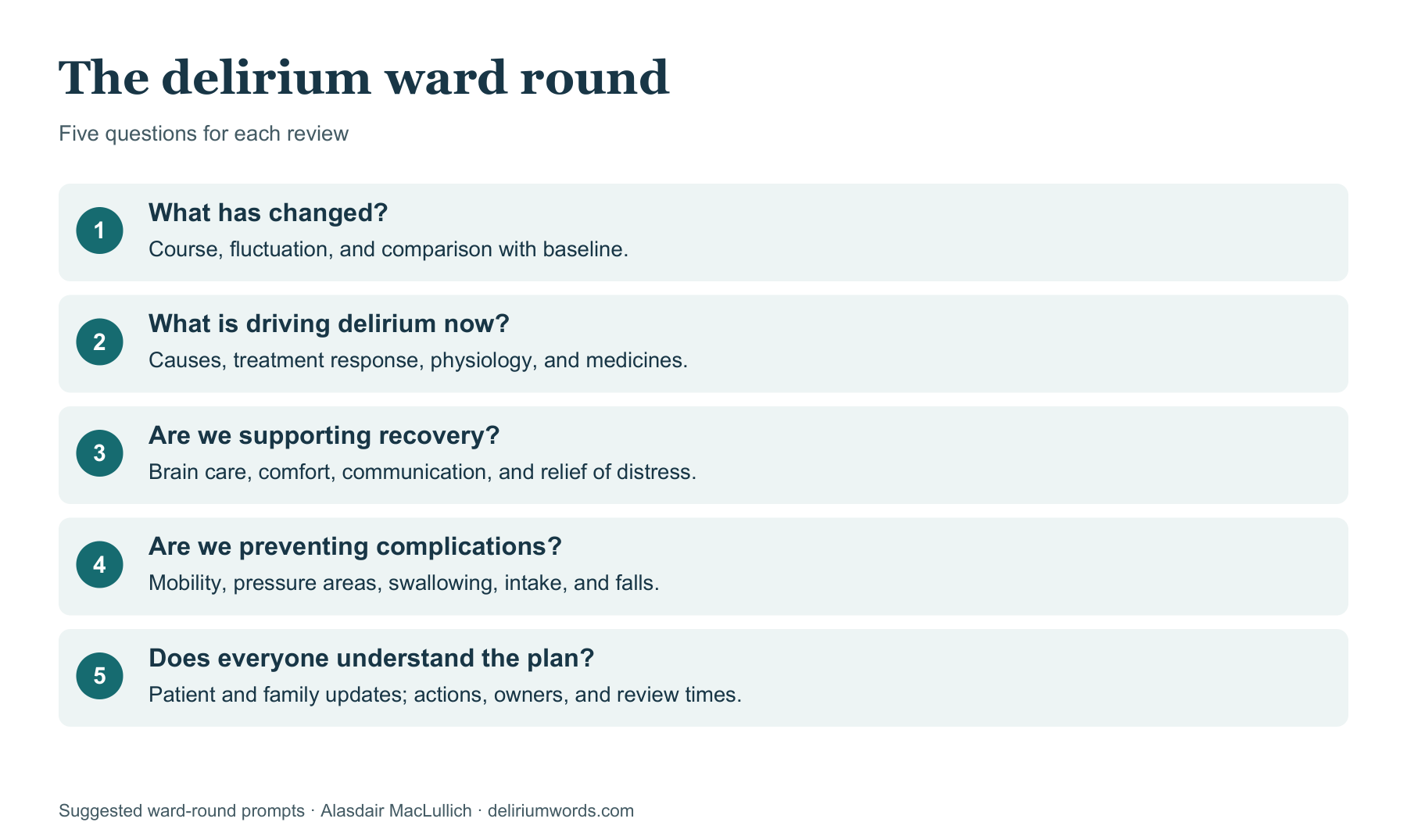
1. What has changed since the previous review?
Start with the patient's course. Is the delirium improving, persisting, or worsening? Which features have changed? Compare alertness, attention, cognition, perception, and behaviour with both the previous review and the person's usual baseline.
The conversation at the bedside is one part of this. Ask the nurse about the night and read the observations from other staff. A patient who speaks quite clearly at 10 am may have spent much of the night frightened and disorientated. I am sure that many clinicians will recognise this.
Use structured delirium assessment when clinically indicated, including to help judge recovery. In my opinion, I think it's reasonable to repeat a delirium assessment tool daily as a patient is recovering, and, in fact, the 4AT has a validation study that supports this (McCartney et al., 2025). Also the APA guideline recommends regular structured assessment of the presence or persistence of delirium, always being careful to keep baseline cognition part of the conversation (Crone et al., 2025).
2. What is driving the delirium now?
Return to each suspected cause. Has the planned treatment happened? Is it working? Is there something new? If the patient has not improved as expected, reconsider the explanation. NICE advises reassessing underlying causes when delirium does not resolve.
Review the physiology, including oxygenation, circulation, temperature, and relevant metabolic abnormalities. Look at trends and examine the patient according to the current findings. New marked drowsiness, focal neurological change, or physiological deterioration needs prompt assessment; it cannot wait for completion of the rest of the checklist.
Pain, urinary retention, constipation, and poor intake deserve explicit attention. These are difficult or impossible for a patient with delirium to report.
Review the drugs every time. Check what the patient has actually received, including as-required doses, recent additions, dose changes, and omissions. Could sedation, anticholinergic effects, accumulating drug concentrations, or withdrawal be contributing? Consider renal function and the continuing need for each medicine. Avoid abrupt withdrawal where that creates further risk. A pharmacist's review can help with the more complicated decisions.
If you or others on the team have newly prescribed drugs to treat distress or agitation (and in most cases this should not be required), then review the need for these, and unless there is a very strong positive reason to continue (intractable distress, major safety concerns), stop them.
3. Are we supporting brain recovery and relieving distress?
Brain care and mind care are useful terms here. Alongside treatment of the medical causes, we need to maintain the conditions in which the brain can recover and attend to what the person is experiencing.
Check whether the patient has actually eaten and drunk enough. Are they able to reach the drink, recognise it, and swallow safely? What help do they need? Review the need for fluids and nutritional support according to the person's condition and agreed goals of care.
A new problem that develops during admission may prolong delirium after the original illness has improved. In my experience, it's not uncommon to see a patient who has received a reasonably good initial set of interventions and shown some improvement, only for the delirium to deteriorate because a clinical team has taken their eye off the ball with respect to dehydration or constipation.
Check sleep, mobility, and sensory support. Are glasses and hearing aids available and working? Can avoidable overnight interruptions be reduced? Can the patient get out of bed safely? Physiotherapy, occupational therapy, and ordinary daily activity should continue as far as the patient can manage, with approaches adapted to their attention and level of arousal.
Keep asking about distress directly when the patient can engage. Are they frightened? Are they seeing things that worry them? Do they understand why they are in hospital? When speech is limited, observe facial expression, movement, responses to care, and signs of discomfort. Distress in delirium can have lasting effects on patients and families (Williams et al., 2020).
The Quick Distress Assessment Tool (QDAT), developed for the McCartney study, combines the questions “How are you feeling?” and “Is anything bothering you?” with observation of physical signs of distress. It gives a rating from 0 to 3, with higher scores indicating greater distress. It is a useful example of making distress assessment explicit, though the tool itself still needs validation (McCartney et al., 2025).
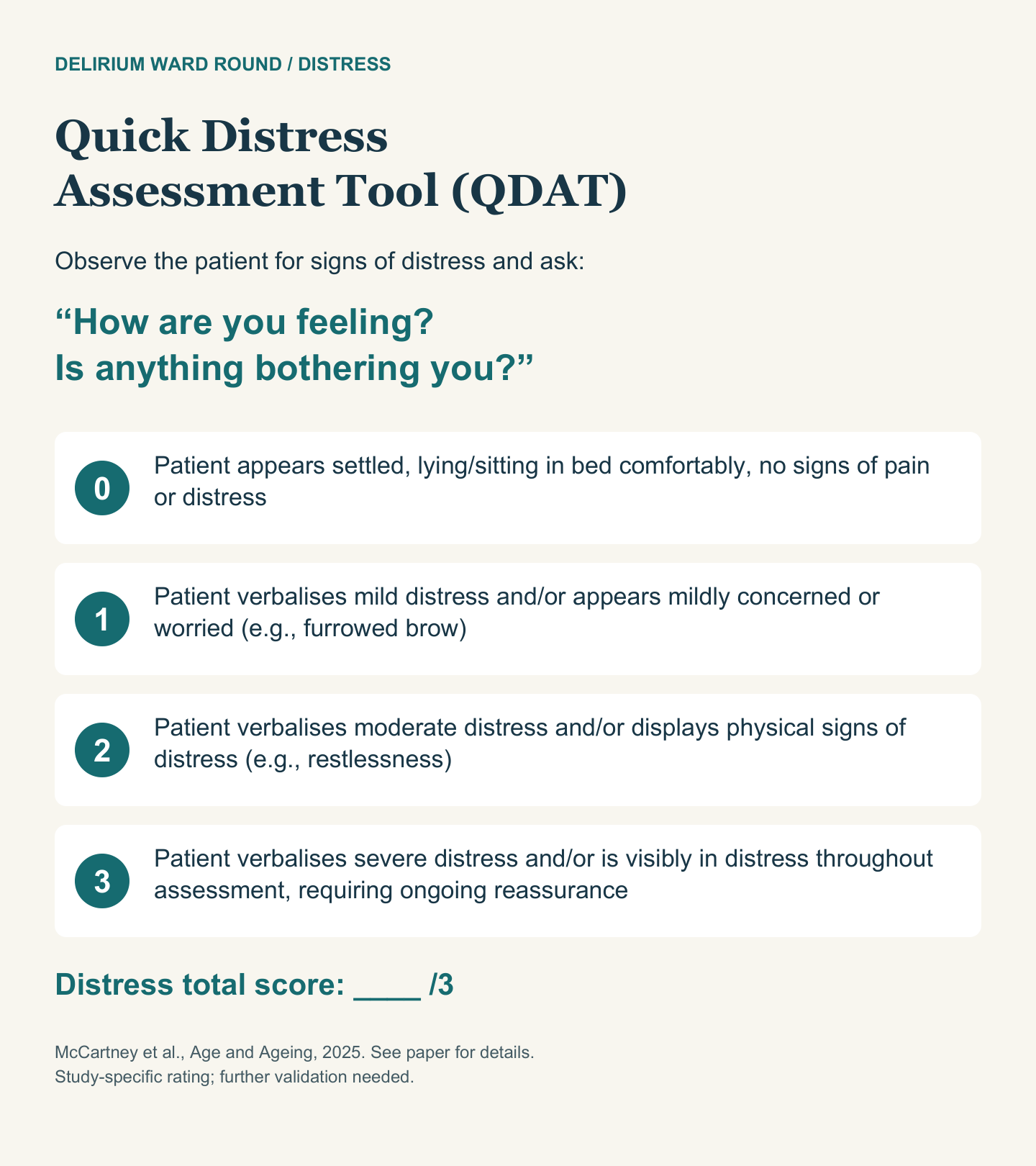
Quick Distress Assessment Tool (QDAT). Adapted from the teaching slide. McCartney et al., 2025.
Respond to the problem you find. Explain who you are and what is happening. Offer reassurance, reduce avoidable noise and crowding, and involve familiar people where helpful. Review pain and other bodily discomfort. Record what has helped so that the next person approaching the patient can use it too.
If medication has been used for severe distress or risk of harm, review the target symptom, benefit, adverse effects, and continuing need. The APA guideline reserves such treatment for specified circumstances after contributing factors and de-escalation have been addressed; antipsychotics should not be used to hasten delirium resolution (Crone et al., 2025).
4. Are we preventing complications?
Review pressure areas and repositioning for patients with reduced mobility. Consider swallowing safety, oral care, and positioning where aspiration is a concern. Check hydration and nutritional intake, including the help required at meals. Review falls risk, access to toileting, and the level of supervision needed. Look for signs that a complication has already occurred, such as pressure damage, dehydration, or aspiration pneumonia.
These problems can themselves add further illness and prolong recovery. Ask the nurses and therapists what they are finding, and what is preventing the care plan from being carried out. A documented mobility plan is of limited value if the patient is stuck in bed because the necessary assistance was unavailable.
5. Does everyone understand the plan?
Tell the patient what is happening in language they can follow, allowing time for a response. Repeat explanations as needed. Involve them in decisions as far as possible, and support communication when considering capacity for a particular decision.
Check family communication at each review. Has somebody explained the diagnosis and current course? What have relatives noticed? What are they worried about? Agree who will provide the next update. Families may also need advice about how to help and what recovery could involve.
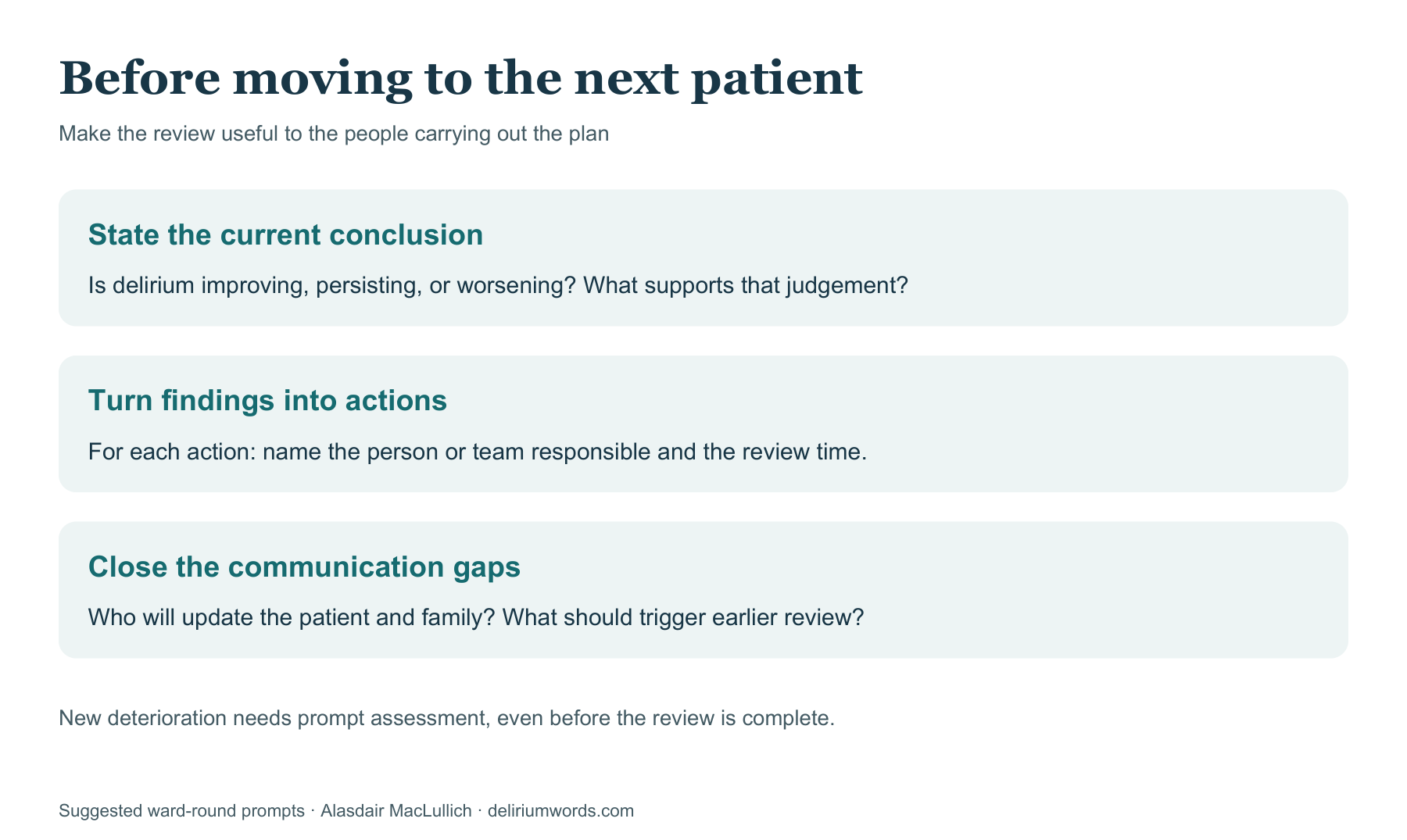
Finish with the current clinical conclusion and the actions arising from it. Give outstanding actions a named person or team and a review time. Include what should trigger earlier reassessment. When discharge approaches, describe any continuing delirium and agree the follow-up with the receiving team.
Making a structured review work
There is a lot to remember when we look after someone with delirium. A short checklist can help us cover the relevant areas more consistently and use the ward round efficiently. The team should be able to prepare the information beforehand, concentrate discussion on current problems, and check afterwards that agreed actions happened.
Early on, unstable physiology may dominate. Later, the main difficulties may be poor intake, frightening experiences, or getting moving again. A shared structure helps the evening and weekend teams understand these priorities too. It should also make it easier to see when a problem has been carried forward in the notes.
We should judge the approach by the care our patients receive: whether causes are treated, physical needs are met, distress is relieved, and families understand what is happening.
I would like ongoing delirium review to become a routine, recognisable part of medical ward rounds. Using a checklist at each round gives us a practical way to work towards that. Give it a try!
Get in contact if you have any suggestions or if you are already using a delirium ward round checklist.
References
Whitby, J., Nitchingham, A., Caplan, G., Davis, D. and Tsui, A. (2022). Persistent delirium in older hospital patients: an updated systematic review and meta-analysis. Delirium, 1, 36822. PubMed.
Treloar, E.C., Ey, J.D., Herath, M. et al. (2025). Optimizing ward rounds: systematic review and meta-analysis of interventions to enhance patient safety. British Journal of Surgery, 112, znaf041. PubMed.
Taylor, C., Peakman, G., Mackinnon, L. et al. (2024). Improving delirium assessments in acute senior health: A quality improvement project for care of the older person. BMC Geriatrics, 24, 781. PubMed.
Williams, S.T., Dhesi, J.K. and Partridge, J.S.L. (2020). Distress in delirium: causes, assessment and management. European Geriatric Medicine, 11, 63-70. PubMed.
Crone, C., Fochtmann, L.J., Ahmed, I. et al. (2025). The American Psychiatric Association Practice Guideline for the Prevention and Treatment of Delirium. American Journal of Psychiatry, 182, 880-884. PubMed.
McCartney, H., Noble, E., Thompson, K. et al. (2025). Validation of the 4AT for assessing recovery from delirium in older hospital patients. Age and Ageing, 54(6), afaf166. PubMed · Full paper · 2026 correction.
Guidance and practical resources
Royal College of Physicians and partner organisations (2021). Modern ward rounds: Good practice for multidisciplinary inpatient review.
NICE (2010, updated 2023). Delirium: prevention, diagnosis and management in hospital and long-term care, CG103.
MacLullich, A. Guide to delirium care, including Delirium 8.
Disclosure: I led development of the 4AT. The 4AT website is among my delirium resources.