Families are often first to notice delirium, but they are rarely given a name for what is happening or a clear guide to what to do next.
In this article
A person changes over a few hours. They cannot follow a conversation. They are unusually sleepy, frightened, restless, or seeing things that are not there. Their family knows that something is badly wrong, but does not know the word for it.
That word is often delirium.
This sequence is painfully familiar. Delirium is common, serious and frightening, yet many families first hear its name only after it has happened. Some never hear it at all. The quiet, sleepy form is especially easy to miss. Relatives may be told that the person is simply old, tired, confused, or showing their dementia.
So I built Delirium Support: a free, independent website for families and carers who need clear information, sometimes in the middle of a very difficult day.
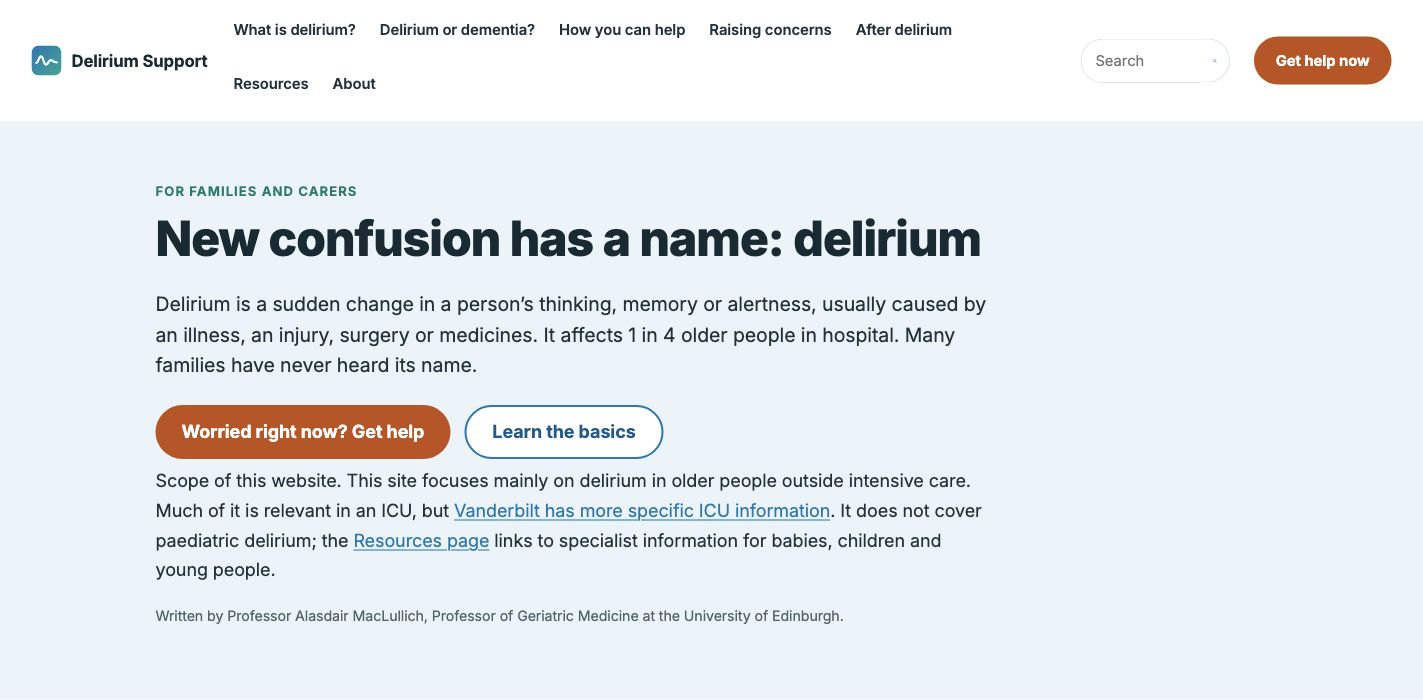
Delirium Support begins with recognition and urgent action.
Why another website was needed
There is good information about delirium online, but it is scattered. Much of it is written for clinicians. Search results mix sound guidance with pages that are outdated, vague, or simply wrong. A family at a bedside should not have to learn the language of a medical journal before finding out what to say to the ward team.
The first aim of Delirium Support is recognition. Delirium comes on over hours or days, unlike dementia, which usually develops over months or years. It can fluctuate markedly. Someone may appear quite clear in the morning and be lost again by evening. Sudden confusion needs urgent medical assessment because some causes are life-threatening (NHS, 2024).
The site therefore begins with action, not theory. Get help now explains who to contact, what to say and which signs require emergency help. Other pages explain what delirium is, show the differences between delirium and dementia, and set out practical ways to help at the bedside.
There is also a section on recovery after delirium. Recovery can be gradual and uneven. Symptoms may persist for weeks or months, and some people do not return fully to their previous level of thinking or independence (NHS Inform, 2025). Families need honest information about that too, not a brisk assurance that everything will be fine once the infection has been treated.
Families hold evidence that the chart does not
A clinical team may have known a patient for twenty minutes. A daughter, partner or friend may have known them for forty years. That person can describe the change from normal: what they could do last week, when the change began, and how it has varied through the day.
Current NICE guidance explicitly says that recent changes may be reported by a carer or relative, and that these changes should lead to a delirium assessment (NICE, 2023). This is not a sentimental extra. It is clinical evidence.
The raising concerns page gives a simple formula:
- Describe the change from normal, with times and examples.
- Use the word delirium.
- Ask a direct question: “Could a doctor assess her for delirium now?”
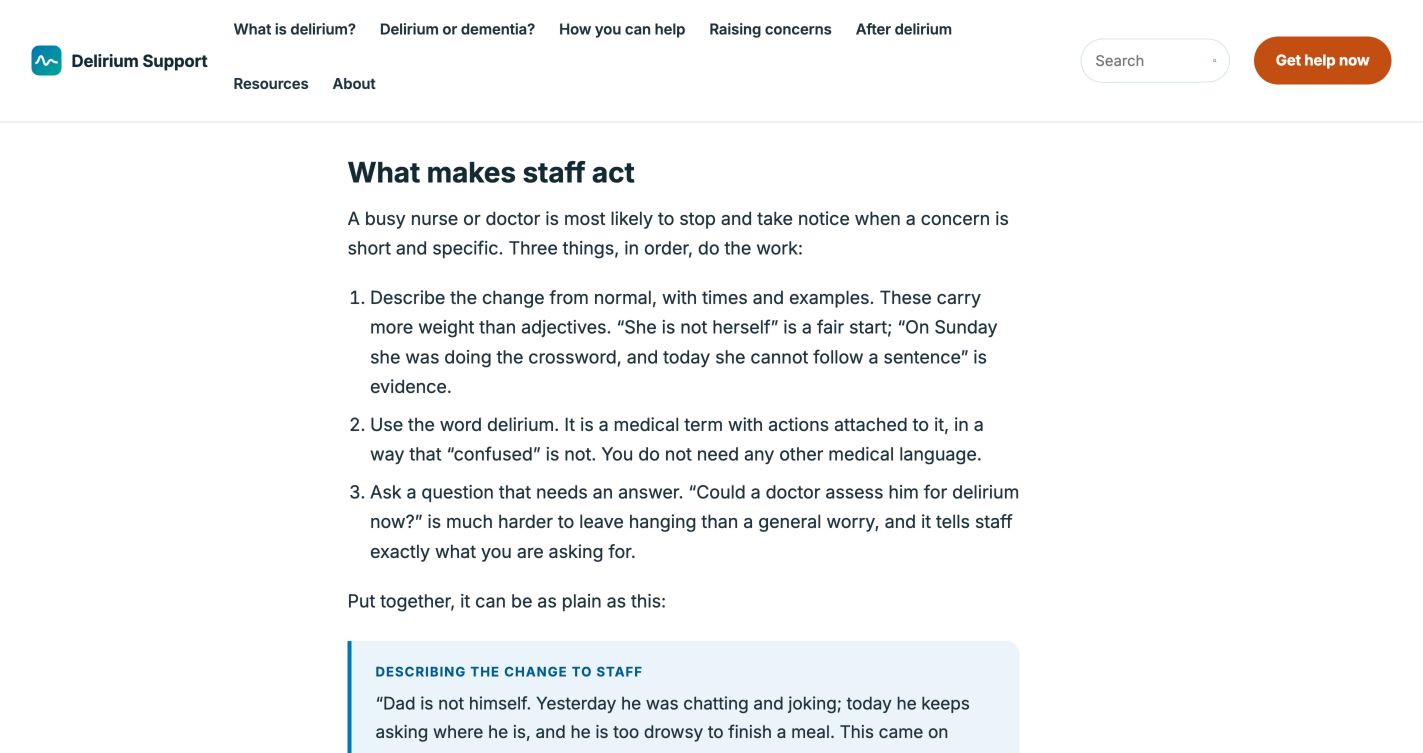
Three steps for turning a general worry into clinical information that staff can act on.
If the concern is not being heard, the page suggests a calm sequence: say it again, speak to the nurse in charge or medical team, and ask for the concern to be recorded. In English hospitals where Martha’s Rule is operating, patients and families can request a rapid review from another team when deterioration is not being answered. It is not available everywhere yet, so families should check locally (NHS England, 2026).
Persistence is not rudeness. Sometimes it is the reason delirium is recognised.
Five guides to print and use
The site includes five free, one-page downloads:
- a delirium action guide
- telling the team
- helping at the bedside
- delirium or dementia?
- raising concerns with staff
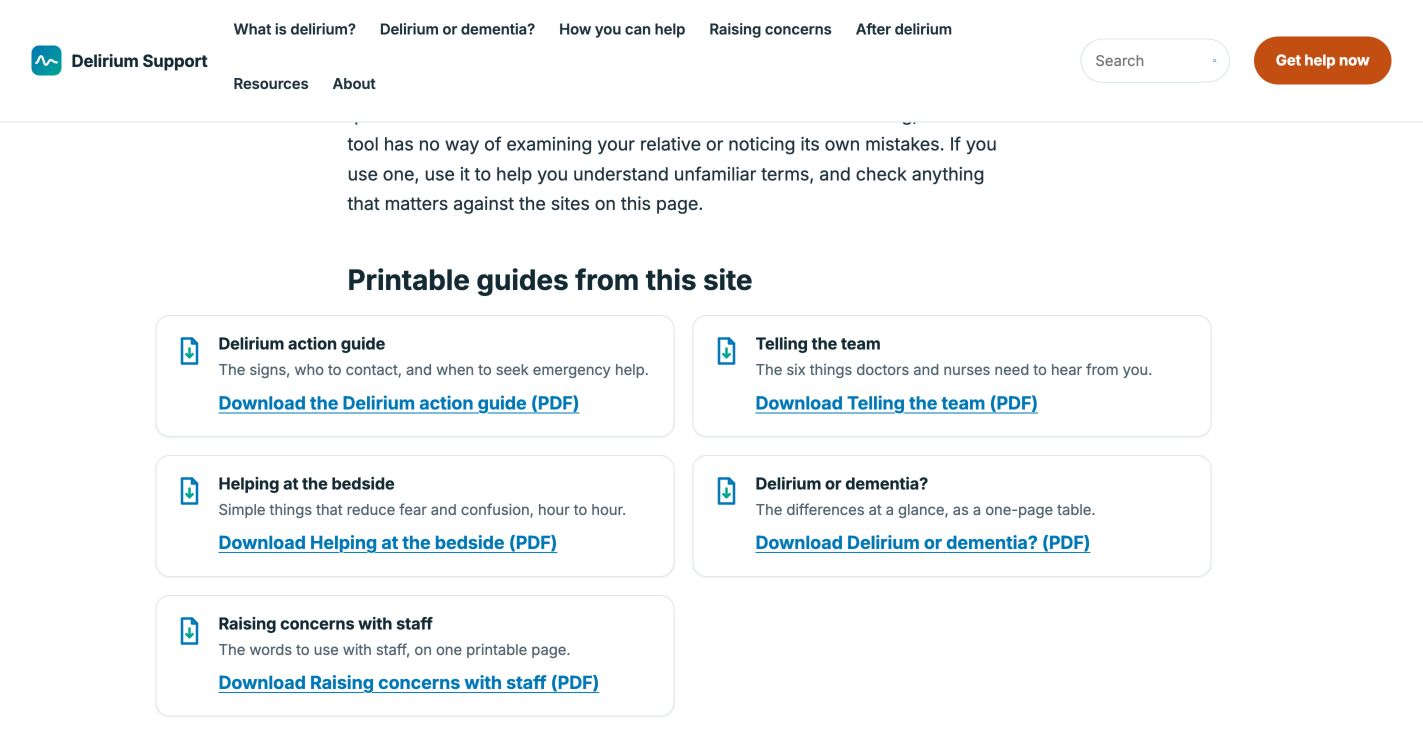
Five free one-page guides for the ward, the home or a relative who does not use the internet.
They can be printed for the ward, kept in a kitchen drawer, or handed to a relative who does not use the internet. That matters. Information only helps if people can find it, understand it and use it under pressure.
I wrote Delirium Support from long clinical and research experience, using NICE, SIGN and published evidence. It carries no advertising or sponsorship. It gives general information, not a diagnosis or advice about an individual person.
If someone you know suddenly becomes confused, seek medical help now. If you work in health or social care, please share the site and print the guides. And when a family tells us that someone is suddenly not themselves, we should treat that sentence as evidence and act on it.
References
- National Institute for Health and Care Excellence (2023) Delirium: prevention, diagnosis and management in hospital and long-term care. CG103. Updated 18 January 2023. Available at: NICE recommendations
- NHS (2024) Sudden confusion (delirium). Reviewed 28 May 2024. Available at: NHS sudden confusion guidance
- NHS England (2026) Martha’s Rule. Available at: NHS England: Martha’s Rule
- NHS Inform (2025) Delirium. Updated 2 July 2025. Available at: NHS Inform delirium guidance